Matador Volunteer

A First-Timer’s Guide to WWOOF-ing

Print This Post Print This Post    8 Comments   Written by Laurie Pickard
If you’re seeking a deeper connection to the land and local economy, WWOOF-ing takes you right to the source.

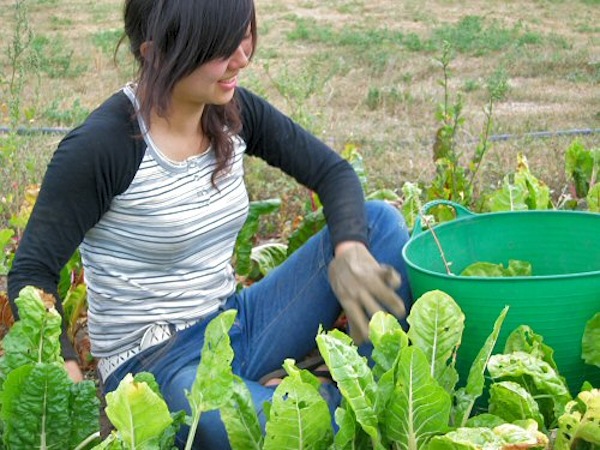
Photo from TinyFarmBlog

First night at the farm

Some time very late I was startled by a rustling, no, more like a crunching sound, coming from the woods behind my tent. I sat up and reached for the knife Don had given me the previous morning. “If something decides to poke its nose into your tent, you want to be able to poke back,” he’d said.
The thing kept coming closer, so close I heard it brushing up against my tent. I could smell it then, a pungent, musky odor. Scared out of my wits, I slapped the side of the tent and let out a smallish scream (I didn’t want to wake anyone up), and heard it run away.

I woke up at first light to the crowing of the neighbors’ rooster and peaked out of the tent cautiously, half expecting to be greeted by a bear or a mountain lion.

Then I saw them - three deer, three little Bambis with their spots still on, munching away at the flora behind my tent. They raised their heads when I came out, stared for a moment with expressions of sheer panic, and then bolted.

Greatly relieved (and only mildly humiliated), I got dressed and prepared for a day of work on the farm.

What is WWOOF?

Farmer and philosopher Wendell Berry once quipped, “Our model citizen is a sophisticate who before puberty understands how to produce a baby, but who at the age of thirty will not know how to produce a potato.”

One of my goals as a WWOOF (World Wide Opportunities on Organic Farms) volunteer, was to make sure that the second half of this statement would not apply to me.

Wwoof-ing, as it is known by WWOOF volunteers (or wwoof-ers), is a great way to take a relatively inexpensive trip that’s also an incredible learning experience. A WWOOF working vacation can range in length from a week or less to an entire season or more.

Through the WWOOF website, potential volunteers purchase a list of farms in the country in which they want to wwoof.

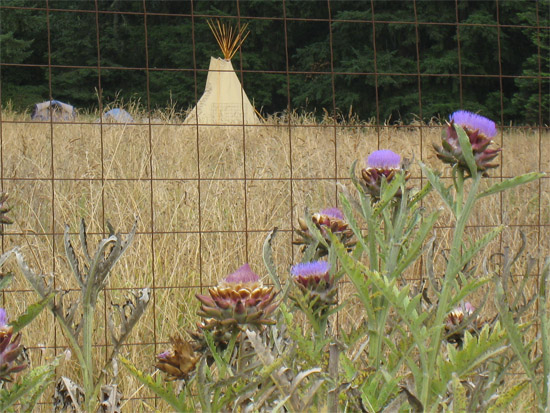
Artichoke flowers in front of Author’s tent. Photo by Jim Proctor.

It is up to volunteers to make their own arrangements with hosts for length of stay and the terms of the exchange. Typically, volunteers agree to work for four hours a day in exchange for room and board. Accommodations range from a simple tent site to a private room. Likewise, the type of labor and skills required range widely. As with everything WWOOF-related, it is up to volunteers and hosts to make arrangements that work for them.

Elkdream farm

I first met Don and Elin of Elkdream Farm at a diner in Eugene, Oregon. Over eggs, we talked about the sorry state of eating in America, the possibilities of permaculture, food production in a post-oil world, and the challenge of shifting from urban living to homesteading.

The couple had lived in San Francisco for many years until a dock fire cut off shipments of food into the Bay. Within two days, grocery store shelves were empty.

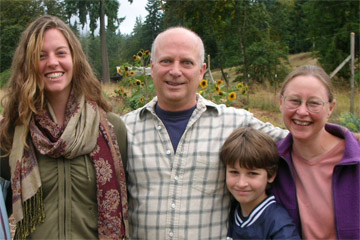
The author with Don, Elin, and Kory of Elkdream farm.

That experience, and the grim reality that oil shortages would produce similar shortages in the future, convinced Don and Elin that it was time to find a place where they could grow most of their own food. They have been in southern Oregon for 17 years now.

I chose Don and Elin’s farm because it was small and diverse. I was attracted to the homesteading element of their operation; they describe themselves as being almost fruit- and vegetable- self sufficient, growing all year round in what Elin describes as less a farm and more “a large garden”, rotating crops to take advantage of different parts of the growing season and increase soil fertility.

When I arrived at Elkdream, the plum trees were bearing fruit, apples were beginning to ripen, and wild blackberries were everywhere. There were also green beans, artichokes, potatoes, lettuce, grapes, tomatoes, kale, broccoli, collard greens, sunflower seeds, rose hips, lavender, blueberries, and garlic.

I spent my first afternoon on the farm harvesting potatoes (Take that, Wendell!), digging through straw and dirt for the golden spuds that lay there like Easter eggs, unconnected to anything. The potato plants had flowered and died weeks before, leaving only the mature tubers just below the ground.

We worked with simple tools – a shovel, a wheelbarrow, a spade – reveling in a quiet interrupted intermittently by logging trucks traveling back and forth from a clear cut up the road. Elin would shake her head in disgust each time a truck drove by.

During my time at Elkdream, I became accustomed to the quiet rhythm of life on a farm. Early mornings harvesting and mulching and planting; long, lazy afternoons reading and resting, avoiding the intense heat of the late-summer sun; hearty dinners Elin and I cooked together with fresh fruit pies for dessert. In the evenings, we might work again, or Don would prepare me a bath of solar-heated water in their large, outdoor bath tub.

Don and Elin took an active interest in sharing their knowledge with me. When I arrived, they presented me with a packet of reading materials. We had frequent discussions on everything from how to farm with less water to the excesses of the American lifestyle. By the time I left Elkdream, I felt a deep connection to Don and Elin and to their way of life.

And I was even sleeping soundly in my tent.

Resources and recommendations

Although WWOOF is the biggest, most popular organization to offer farm work exchanges, there are many others.

  • 1. Transitions Abroad offers a list of international farm work programs that includes WWOOF and others.
  • 2. Help Exchange is another organization that connects volunteers with farms and ranches, as well as hostels and even sailing boats.
  • 3. For those seeking an experience living in community, there are several eco-villages that offer internship opportunities. For more information on eco-villages, see the Intentional Communities website. Larger eco-villages such as Earthaven , Dancing Rabbit, and Lost Valley offer educational internships that focus on building, planting, and organization.
  • 4. Idealist.org offers a searchable data base of internship and volunteer opportunities in a variety of fields, including farming and agriculture, in all 50 states and around the world.
If you go:

Choose your farm wisely. If you don’t like animals, pick a farm that doesn’t keep them. Likewise, if you’re dying to learn how to milk a cow, don’t go for a farm that only grows vegetables.

Be clear about your arrangements with your host. Make sure you know what kind of work you will be doing, how much work you will be expected to do each day, what meals will be included, and where you will be sleeping.

Choose when to go. If you go early in the season (late spring – mid summer) you will probably be doing different work than if you go during the harvest (late summer). Since Don and Elin plant throughout the year, I was able to do multiple kinds of work, but this may not be the case at all farms.

A few essential items to bring: good work gloves, a sun hat, sunscreen, shoes and clothes that can get muddy.

Laurie Pickard

Laurie Pickard is a full-time student and T.A. in Geography. She lives in Philadelphia, where she's worked waitressing, driving an ambulance (for a day), translating and editing books in Spanish, line cooking, teaching music lessons, teaching yoga, playing guitar and singing, and teaching middle school science.

| Stumble it!

8 Comments »

  1. Comment by Uncle B — May 11, 2008

    Here in Lakefield Ontario, Canada, we are encouraged by law to go organic this year, and this is going to make gardening a little more challenging than before. I grow squash among other things, and my concerns are towards eradicating vine borers. I do compost, and use some companion planting, but to suddenly have to go totally without pesticides is going to be a challenge for sure!

  2. Comment by Cathy — May 13, 2008

    Sounds idyllic. I wonder how long it took them to learn how to farm efficiently enough to be somewhat self-sustainable. I agree, unfortunately, with Wendell Berry that most of us do not possess the knowledge to grow in order to feed ourselves—something that is even more difficult in climates where growing year-round is impossible.

  3. Comment by Peter — May 15, 2008

    I encourage travelers to consider volunteering at farms while they travel. As a former host in the WWOOF program, I hosted guests at my farm in Nicaragua. Eventually at the farm, we decided that we would only host guests on a “work exchange” basis after a few weeks as a paying guest, because many guests were unable to adjust quickly to the Nicaraguan work environment. As a result, the farm was removed from the official list of the WWOOF organization. I strongly encourage volunteers who go to poorer countries to donate some money to the farm in their adjustment period, because the reality of providing food and shelter is not appreciated or properly compensated-for by the low productivity of the guests.

  4. Comment by Sarah Hill — May 15, 2008

    WWOOF is a great organization. With WWOOF I was able to travel my way around Australia and New Zealand for 16 months. I met wonderful people, had amazing experiences, and still keep in touch with many of them. I was introduced to bee-keeping, dairying, birthing cattle, milking goats, pulling invasive plants, and of course new foods and ideas on farming and life in general. WWOOF is available in so many countries, that any traveler looking for more than the cookie-cutter tours and hotels, should definitely look into it.

  5. Comment by Melodee Monroe — June 3, 2008

    Those in climates that prohibit year-round crops would be wise to cultivate the art of canning. I’ll bet the people living on these farms/large gardens know how to can and would be willing to share the info.

  6. Comment by keerthi — June 4, 2008

    i want to work here

  7. Pingback by 10 Volunteer Opportunities that Allow You to Travel For Free — July 2, 2008

    […] For more information, check out A First-Timer’s Guide to WWOOF-ing. […]

  8. Pingback by 10 Volunteer Opportunities For Free Travel — July 2, 2008

    […] For more information, check out A First-Timer’s Guide to WWOOF-ing. […]

Leave a comment

Please note: If this is your first comment, it will be moderated.

Get Matador by Email


Jump To Category:

Latest In Volunteer Tips

Latest Comments